

ProDev #3: The Pillars of Individual Contribution, Pt. 1

Hey, Caique here with your weekly issue from ProDev! ✌️ In this newsletter, I give practical advice on how to be a professional in the tech business.
This week I start to experiment with a new format!
“The Pillars of Individual Contribution” will be a series of articles delivered throughout the month of June. Splitting the issues is my way of forcing a spaced repetition so you can get the most out of it.
In this first article, we will cover the framework in a nutshell and set the stage for the upcoming issues that will give you a lot to reflect on and incorporate in your work.
If you are not a subscriber, you might miss the next articles. Subscribe for free and get weekly issues directly to your inbox.
In tech-centric organizations, an individual contributor (IC) is someone who primarily works independently to produce work that directly contributes to the organization's goals.
The term "individual contributor" emerged in the 20th century as a way to differentiate from a "manager". When companies began adopting hierarchical management structures, employees who were responsible for producing work but did not manage other people were referred to as individual contributors.
In recent years, there has been growing recognition of the importance of ICs. Many organizations now develop career paths for ICs that allow them to advance in their careers while still focused on technical work without being forced to pursue the management path. These career paths offer the same prestige, financial compensation, and authority as their equivalent management levels. As a person grows in their role, they operate with more autonomy and produce more impactful work.
Individual contributors are the heart (and brains) of technology organizations because they are the ones producing high-quality technical work that fulfills the organization's purpose.
But, in a tech organization, no one achieves success alone. Collaboration is key. So, how might we measure individual performance based on the outcomes of collective efforts?
Also, terms like "impact“ and "growth“ are extremely vague and subjective to many factors. So, how might we clearly communicate our past, current, and future individual performance?
The Pillars of IC in a nutshell!
The Pillars of Individual Contribution is a lightweight framework for individual contributors to assess and communicate their personal growth and performance. It proposes a systematic approach to establishing assumptions, promoting actions, and measuring impact.
It assumes tech organizations have the following characteristics:
sociotechnical systems;
non-linear;
complex; and
the product of the interactions of their individuals.
In this context, the performance of an individual contributor is sustained by the following core competencies:
Technical Excellence
Leadership
Business Awareness
Human-Centricity
Empiricism
In addition, impact evolves through the scopes of influence:
Self
Tactical
Coordination
Strategic
The Core Competencies
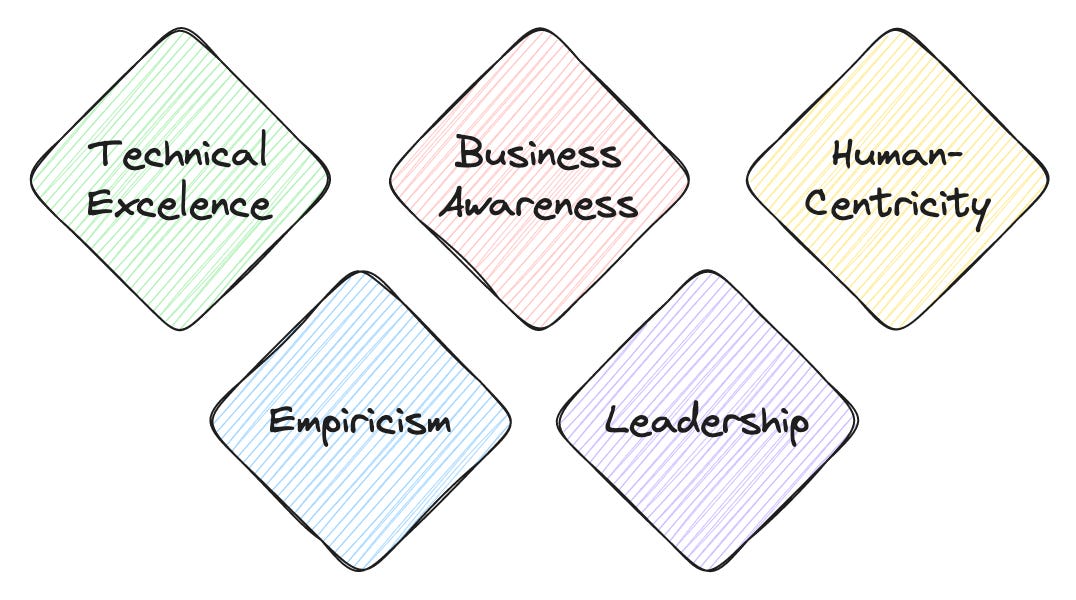
Technical Excellence refers to the abilities acquired and improved through experience and education. It is the knowledge and competence in your field that allows you to produce high-quality technical work. This relates to the skills that make your competence unique and distinguish your job from others.
Leadership is the ability to produce interactions that create and multiply the impact at different levels. This relates to self-management, influence, sponsorship, mentoring, coaching, and political capital.
Business Awareness is related to making decisions aligned with business goals and results. This requires understanding how the organization makes money, who the customers are, what the competitors are doing, and how your actions affect the business.
Human-Centricity considers the people involved and affected by your actions. It is the understanding that organizations are made by humans and for humans. This relates to emotional intelligence, empathy, communication, collaboration, feedback, and emotional responsibility.
Empiricism refers to applying methodical experimentation to draw conclusions. This relates to critical thinking, logical reasoning, applying the scientific method, and data-driven decision-making.
The Scopes of Influence
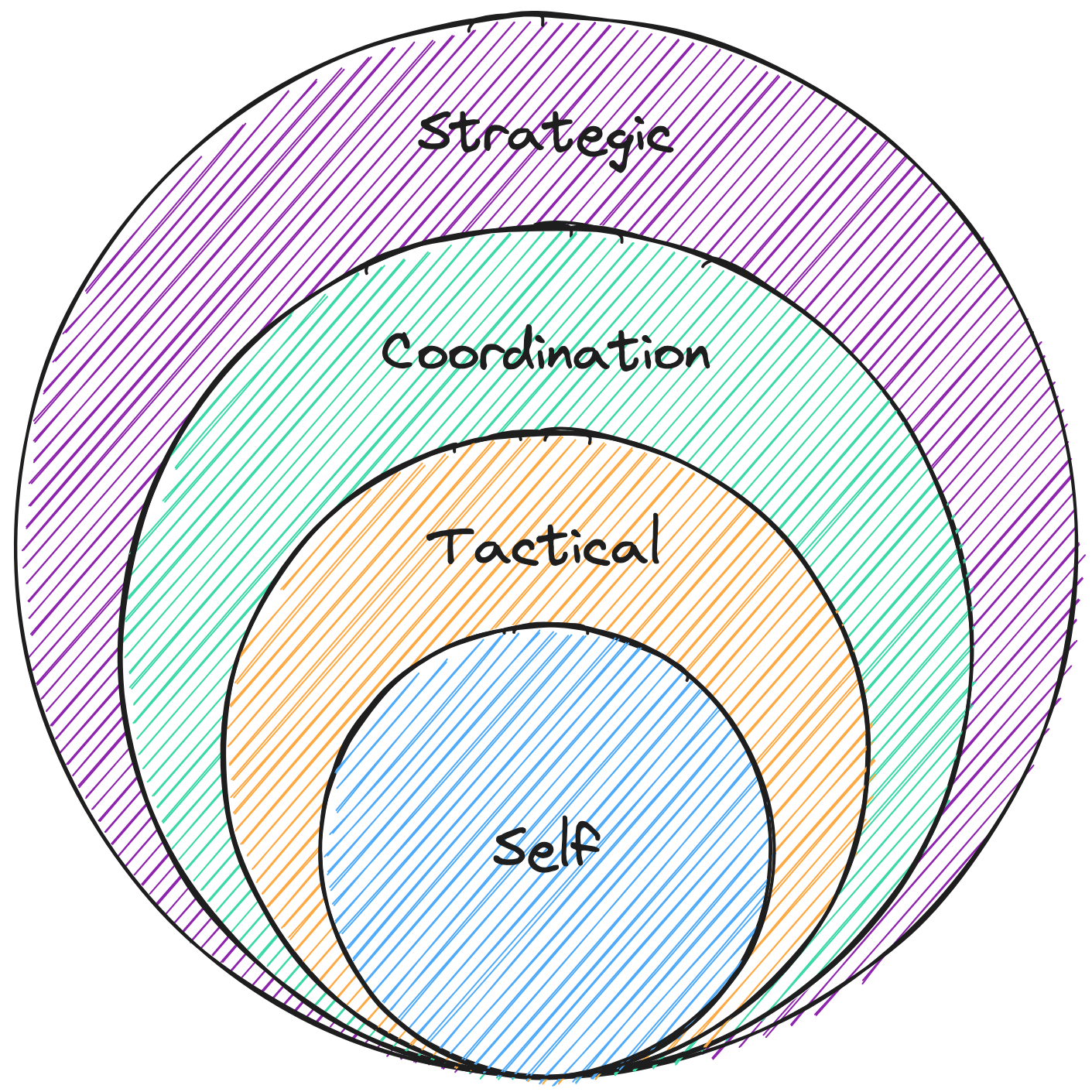
Self refers to a person's individual actions that impact only themselves. It is the smallest scope of influence and includes efforts related to topics such as personal growth, individual learning, self-motivation, and self-awareness.
Tactical refers to individual actions that impact day-to-day activities. This is related to the execution of tasks independently or as part of a team to produce high-quality technical work. Most individual contributors are focused on tactical efforts.
Coordination refers to actions that impact multiple parts of the organization. Examples are leading a cross-team initiative, connecting two or more teams to deliver a feature, identifying dependencies, or solving conflicts.
Strategic refers to actions that impact the entire organization or a significant part of it. Examples include setting the technical vision for a whole domain, defining yearly business goals, negotiating with commercial partners, or representing the organization to the external world.
What about…
…execution?
Many frameworks define "execution" or "the ability to complete a given task" as a way to describe growth.
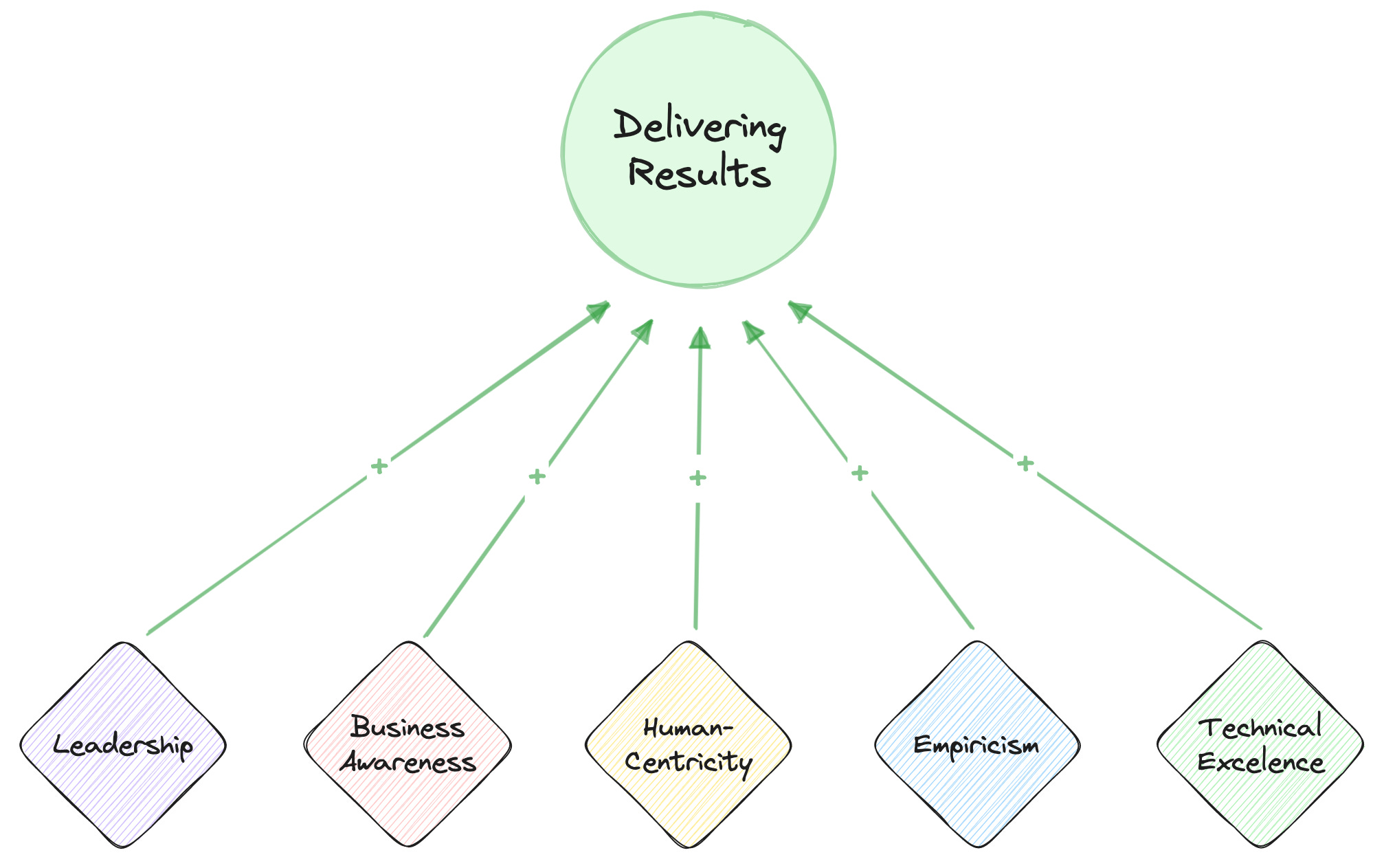
I believe that execution, just like impact, is both an expectation and a consequence of development in other areas. As you grow in the five dimensions, it is naturally expected that you will execute with mastery by leveraging your proficiency in one or more dimensions.
In a similar manner, other consequences include quality, consistency, ease, and confidence. I like to use the term "delivering results" to summarize all positive outcomes.
…job titles?
Each company will have a different way to assign job titles based on your proficiency in certain competencies. In addition, depending on your field or expertise, other specific criteria need to be met to justify a certain job title.
This framework assumes that any job title is both a recognition of past performance and an expectation of future growth. More importantly, job titles are a consequence of growth and not the goal.
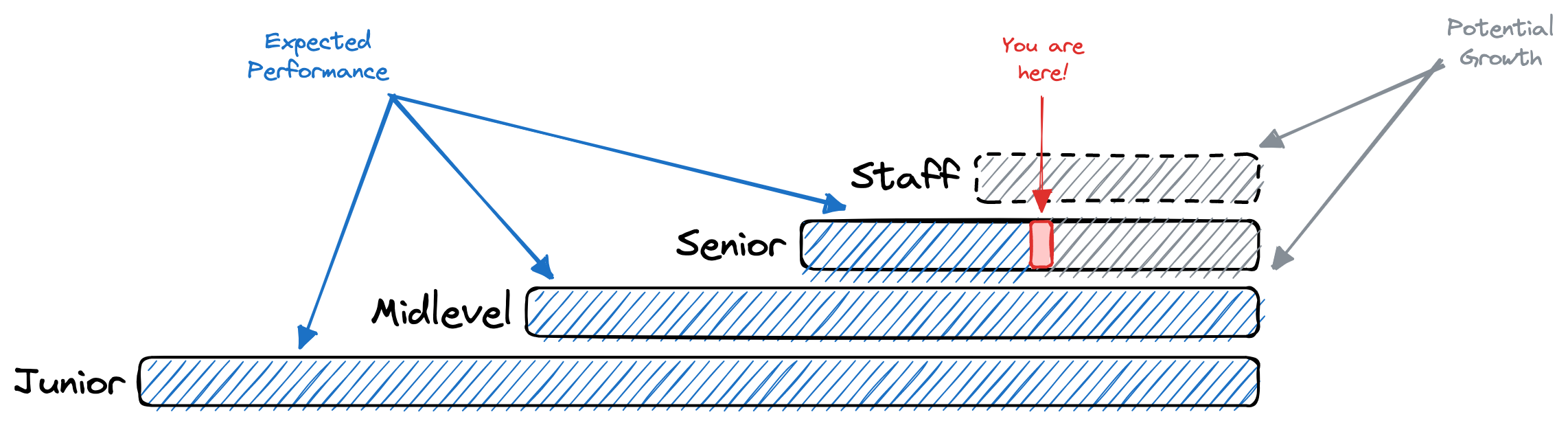
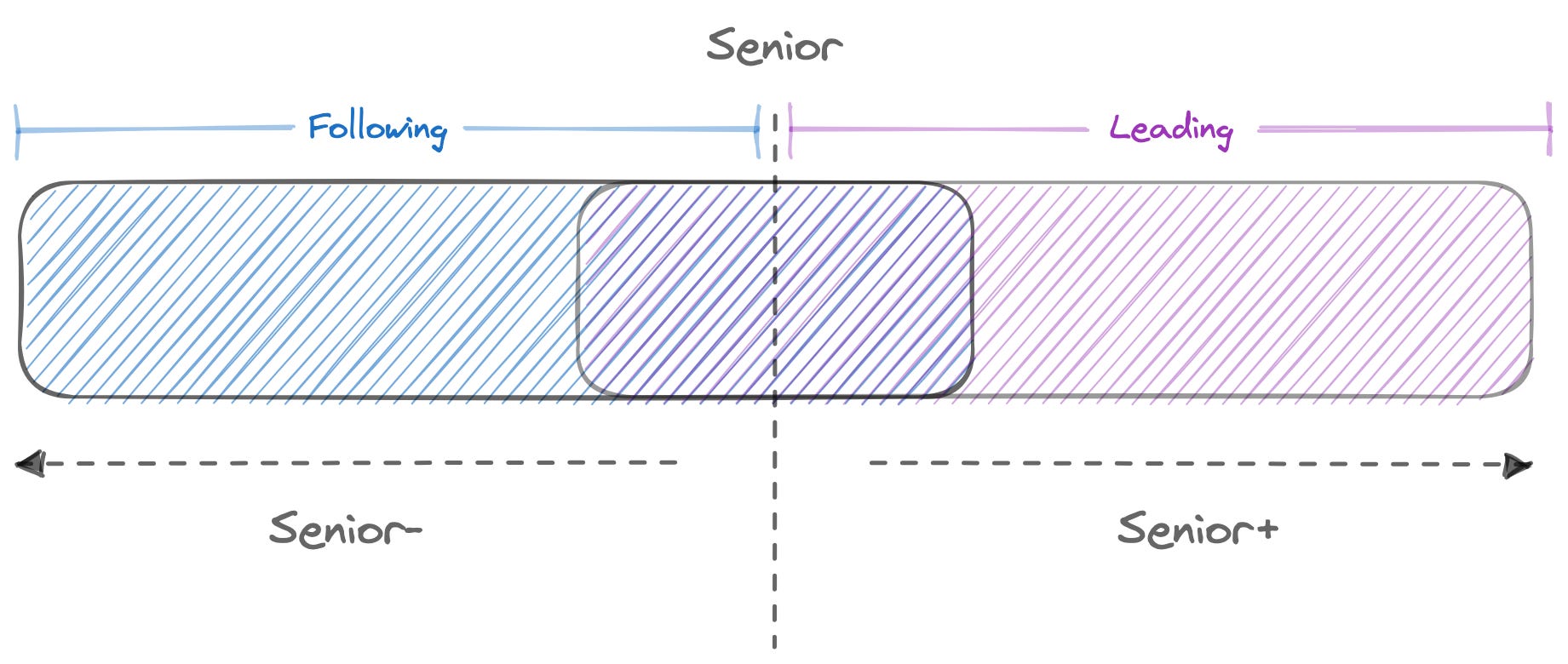
I constantly use the Senior level as a reference when discussing proficiency, behaviors, and expectations. First, because the Senior level is a constant in most career ladders. Second because becoming a Senior is an inflection point that shifts the expectations from following others to leading others - and this is only possible when you become proficient in different core competencies (more on that when we deep dive into Leadership).
I’ll use the terms Senior+ and Senior- to refer to the levels above Senior and the levels below, respectively.
…metrics?
This framework offers the heuristic foundation so you can establish a clear “cause-and-effect” relationship between your contributions and your organization's success. Later, we will cover how to quantify these heuristics so you are able to craft solid arguments about your performance and growth.
The next series of articles will cover how to define, collect, and present performance indicators.
Pro Tips
You have to fill in the blanks
These pillars are a foundation for reflection and communication. They are best used as a common language between you and whoever you want to discuss what “good, bad, and ugly” individual performance and contribution look like.
The framework is not prescriptive or exhaustive. You will have to fill in the blanks with the details of your area of expertise, the context of your organization, and most importantly, your experience in the role.
Each pillar represents an individual advantage that contributes to your overall performance. Leveraging any of the pillars will result in improvements, but depending on your personal goals, focusing on one pillar may lead to more results than another.
If you don't know better, striving for a balanced proficiency across all core competencies and aligning your scopes of influence with the expectations of your role is a great strategy to achieve high performance.
Scaffolding
Every person has some level of proficiency in each and every competency. But, to achieve performance that meets the expectations of a certain title, it is important to be intentional in the development of the competencies that makes sense to you.
The competencies are dependent on each other, so developing one indirectly affects the others and gives you leverage to intentionally focus on developing them.
As I mentioned in ProDev #1, the principle of scaffolding can be applied here.
You can leverage your proficiency in one competency to support the development of another.
A few examples are:
leverage your Technical Excellence to develop Leadership by stepping in as a Tech Lead or Acting Engineering Manager;
leverage your Technical Excellence to develop Human-Centricity by coaching a less experienced peer;
leverage your Business Awareness to develop your Technical Excellence by pairing up with a more experienced peer.
The combinations are endless. The practical advice is to focus on your strengths, be conscious of your points of improvement, and act intentionally to fill the gaps.
Relying solely on your strengths to avoid developing other competencies is the most detrimental path because a lack of proficiency in any area will eventually limit your growth.
It's your turn!
While you wait for the next publications, I highly recommend you check out the work in this area from these great people:
"The Staff Engineer’s Path" by Tanya Reilly
"How to Build a Strong Career in Tech" by Thiago Ghisi
"The Trident Model of Career Development" by Patrick Kua
“The Staff Archetypes” by Will Larson
"Engineering Ladders” by Jorge Fioranelli
"The Software Engineering Job Ladder” by Chuck Groom
What should you expect next?
In the next article, I will describe the characteristics of tech organizations and how they behave as sociotechnical, complex, and non-linear systems. We will also cover how individual actions affect the organization, common dysfunctions of organizations, and how to leverage these conditions to maximize your individual performance.
After that, we will deep dive into each of the core competencies. We will give a detailed explanation of the semantics, how it correlates with each other, examples, and provide practical tips on how to improve your overall performance.
At the end of this series, you will have a framework that not only guides your personal growth but helps you to communicate your intentions and achievements to others.
I am super excited about this series! I have a lot to share and I hope you enjoy reading as much as I'm enjoying writing. As always, I'm looking forward to your feedback and ideas.
Thanks for reading and have a wonderful week! 👋